Development of an Aggregated Dynamic Model of Distributed Energy Resources (DERs) for Stability Studies of Emerging Power Grids
Project Partners: Deakin University, Monash University, Australian Energy Market Operator (AEMO), Ergon Energy, Energex, Queensland Electricity Transmission Corporation Ltd (Powerlink), C4NET







Project aim
To develop an aggregated dynamic model for Distributed Energy Resources (DERs) in a low-voltage (LV) distribution network, we need a simulation model that can capture the combined behaviour of hundreds of interconnected DERs. In future studies, this model will serve as a building block for developing dynamic models of the integrated power system, including assessing power system strength and measuring voltage fluctuations at specific locations throughout the entire system when subjected to disturbances.
Objective 1.
Development of detailed PSCAD (Power Systems Computer Aided Design) model of typical single-phase DERs.
Objective 2.
Development of an aggregated dynamic model of single-phase DERs on a distribution feeder as seen from its distribution transformer.
Methodology
Single-phase inverters will be analysed to develop a reduced-order aggregated dynamic model for multi-single-phase DERs. The proposed model will include a necessary and sufficient set of functional blocks aiming that the reduced-order aggregated model reflects the actual dynamic behaviour of the original system. The aggregated model will take into account the requirements of relevant Australian standards.
This project will include the following stages-
Stage 1. Dynamic modelling of rooftop PV systems:
DERs in distribution networks, mostly rooftop PV systems, are based on single-phase inverters with relatively low power generation. Understanding the dynamic behaviour of these inverters is crucial for the distribution network service providers (DNSPs) to manage the operation of the distribution system during normal and abnormal conditions. On the other hand, the operator of the bulk power system needs to include dynamic models of DERs in their stability studies. Including detailed dynamic models of all inverters in a distribution network is not feasible for modelling wide-area networks.
Thus, the first stage of this project is to understand the behaviour of the single-phase inverters and how they interact with each other under various operating conditions. Though there has been some effort to develop models of some PV systems, those models do not capture important aspects, such as various control schemes and modes and various operating conditions, including unbalanced operation. In addition, existing models do not incorporate Australian Standards, which means they’re not customised for the Australian power grid. Thus, a single-phase inverter model will be developed considering the above considerations. The model will be experimentally tested and verified.
Stage 2. Developing a scalable aggregated model of single-phase rooftop PV systems:
When analysing a wide-area distribution network, a cluster of inverters can be combined in a single aggregated model, preserving their dynamic characteristics. In this stage, an aggregated model will be developed by obtaining a reduced-order representation of multi-inverters with sufficient fidelity. A feeder connected to several DERs on single phases will be modelled as one aggregated dynamic, active load from the viewpoint of a network boundary point of connection (NBPoC) upstream of the feeder.
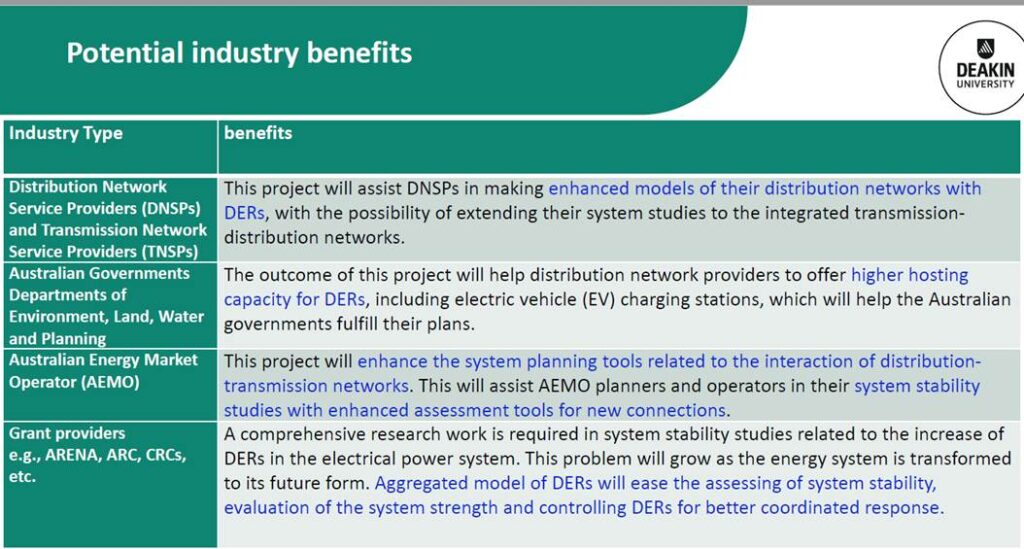
Potential Industry benefits
Categories: New Technologies