Transitioning Bendigo’s Energy Economy, a Feasibility Study of Renewable Energy
Project Partners: City of Greater Bendigo, RMIT University, C4NET


Background
The Greater Bendigo City Council (the Council) has a strong commitment towards a renewable energy transition, both for the operations of the City of Greater Bendigo (the City) and for the municipality and wider region.
Council’s revised Climate Change and Environment Strategy 2021-2026, expresses targets to achieve zero carbon in the City’s operations by 2030 and zero carbon across the Greater Bendigo municipal community by 2030. The Strategy includes a target for 500% of the municipality’s 2021 energy demand to be generated through local renewable energy by 2036.
The study area was 235 ‘statistical area 1s’ (SA1s) in Bendigo’s urban and peri-urban area that had LiDAR coverage.
Bendigo, as the regional centre and with abundant solar potential and the rapid update of renewable resources such as rooftop PV, has the potential to become a crucial driving force in the implementation of the Central Victorian Greenhouse Alliance (CVGA) Loddon Mallee Renewable Energy Roadmap (the Roadmap).
The Roadmap provides a snapshot of the opportunities and obstacles the region faces as it moves to a decentralised renewable electricity energy system.
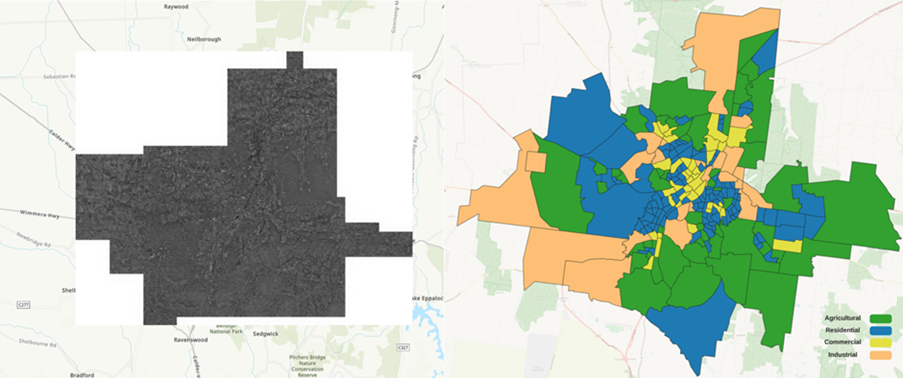
LiDAR coverage in City of Greater Bendigo (Left) and the studied SA1s in this project (Right)
This Renewable Community Energy Transition (RCET) project aims to support the City’s leadership of the community transition to zero carbon, and local renewable energy resources. It investigates the opportunities and challenges, within the study areas of:
- Increasing the overall area percentage of rooftops with solar panels.
- Introducing community renewable energy retail, and generation, through two types of management strategies, namely Virtual Power Plant (VPP) and Peer-to-Peer (P2P) community renewable energy trading.
Conclusion / Recommendations:
With the anticipated growth in renewable energy, and the expansion of the renewable powered economy in the region, the City has the potential to become a driving force in the Central Victorian Greenhouse Alliance (CVGA) roadmap to lead the renewable energy transition in the Loddon Mallee regional area.
The existing challenge is that a renewable energy transition comes with requirements for financial capability, as well as community support and awareness. Both VPP and community renewable energy P2P trading have great potential to support the Council’s ambitions in transitioning to renewable energy.
- It is recommended that the City advocates for, and pursues a rapid growth strategy in both rooftop PV and BESS systems.
- The ideal estimated growth rates are 132.5 MW/year for rooftop PV and around 7,800 units/year for BESS (unit capacity of 13.5 kWh). With this rate, the study area is expected to achieve demand offset of 48.36% in 5 years, and 67.98% in 10 years, based on the demand rate estimated by the Australian Energy Update 2020.
- This project identified communities which have the most significant improvement in economic values and carbon emission reductions, with extra battery system capacity.
- With the current level of PV and battery system capacity, a community-based VPP is not a financially viable option. However, within 5 years – 10 years time, with the expected growth of solar and batteries, VPP has significant potential to support the City’s future growth of renewable energy systems, and unlock the distributed system’s values amongst the communities.
- It is therefore recommended that the City prepare for the potential deployment of future VPP networks. For example, conducting further feasibility studies that cover electricity distribution network infrastructure, frequent updates of renewable energy uptake data, and trial implementation of VPP in the communities.
- It is recommended that the Council or another entity, maintain frequent updates on the renewable energy data, such as installed system capacity, usage and generation. This information is of great value for advising future developments and to calibrate renewable energy transition strategies.
Alternatively, the Council can advocate to Victorian Government agencies regarding the work performed to date and future opportunities, in order to advance data collection and ongoing maintenance moving forward.
For more information please see https://www.sealsolarlab.com/
Media & Resources
Report • August 2022
Transitioning Bendigo’s Energy Economy: a Feasibility Study of Renewable Energy
Categories: Major Projects